
A 25-basis-point increase would restore some real monetary restraint when expected inflation has risen, liquidity remains easy and growth is strong, points out Amarendu Nandy.
Reserve Bank of India Deputy Governor Rohit Jain has stated that India cannot rely solely on bank balance sheets to fund the extensive investment required for its 'Viksit Bharat' (developed India) goal by 2047, emphasising the critical need for deeper corporate bond, foreign exchange, and derivatives markets.

Keeping KYC information accurate and current should, therefore, be seen not merely as meeting a regulatory requirement, but as an important part of safeguarding one's own financial identity and safety, explains RBI Deputy Governor J Swaminathan.

Foreign Currency Non-Resident (Bank), or FCNR (B), deposits mobilised under the Reserve Bank of India's (RBI's) concessional swap facility may have already surpassed the amount raised during the 2013 scheme in just about 45 days, prompting SBI Research to sharply raise its estimate for inflows under the facility to $65-70 billion.

Tata Sons, the holding company of the Tata group, continues to be classified as an 'upper-layer non-banking financial company' (NBFC) by the Reserve Bank of India (RBI), despite its application to deregister as an NBFC-Core Investment Company (CIC) remaining under consideration. This classification subjects it to enhanced regulation and a mandatory listing requirement, which remains uncertain.

The RBI seems to be acknowledging that all deposits are not equal -- a deposit with a lower run-off assumption is inherently more valuable than one that could disappear overnight, points out Tamal Bandyopadhyay.

The Reserve Bank of India (RBI) has declared a record Rs 2.87 lakh crore dividend to the government for the 2025-26 financial year, offering significant financial flexibility amidst global economic uncertainties.

It is because dealing with a regulatory system that is largely headed by retired IAS officers then becomes relatively easy, points out A K Bhattacharya.

The Indian government has introduced a 0.4% transaction fee on Unified Payments Interface (UPI) payments exceeding Rs 2,000 for merchants, effective October 15, marking the end of nearly six years of free service. Person-to-person transfers and small-value transactions below Rs 2,000 remain free. The new Merchant Discount Rate (MDR) is capped at Rs 300 for transactions above Rs 75,000, with differentiated rates for essential sectors and investments, and safeguards to prevent costs from being passed to consumers.

Inflows into foreign currency non-resident (bank), or FCNR (B), deposits have significantly underperformed market expectations, leading to a more than 1 per cent depreciation of the rupee against the dollar this week. Analysts point to fading RBI support measures, tepid interest due to rising global bond yields, and narrowing interest rate spreads compared to 2013 as key challenges.
Members of the Reserve Bank of India's (RBI) Monetary Policy Committee (MPC) have indicated that interest rate hikes may be necessary sooner rather than later, as headline inflation is projected to rise from its current benign levels in the coming months, according to the minutes of the August review.

The Reserve Bank of India (RBI) is widely expected to keep its benchmark repo rate unchanged in the August monetary policy review, with economists citing elevated inflation risks and the pending closure of the FCNR(B) deposit scheme as key factors. Most anticipate a 'Neutral' policy stance but with a hawkish tone due to geopolitical tensions, high crude oil prices, and an uneven monsoon.

"Our endeavour is to bring headline inflation in line with the target over the medium term," said RBI Governor Sanjay Malhotra, addressing concerns about the central bank's policy stance and economic outlook.

'In fact, when monetary policy has been deployed, it does not distinguish between types of shocks. It goes straight for the kill.'

The Indian government has introduced a 0.4% Merchant Discount Rate (MDR) on UPI person-to-merchant (P2M) transactions exceeding Rs 2,000, effective October 15. This move ends nearly six years of fully free UPI payments, though person-to-person (P2P) transfers and small P2M payments remain free. The charges aim to bolster investment in UPI infrastructure, with specific exemptions and caps for essential sectors.

RBI says polymer notes have a significantly longer lifespan, potentially reducing printing costs and replacement frequency.

The Reserve Bank of India's Financial Stability Report indicates that the interim peace deal between the US and Iran has favourably shifted the balance of risks, reducing headwinds from the West Asia conflict. However, it cautions that exchange rate volatility could increase if crude oil prices spike due to delayed normalisation of supply chain disruptions.

Bond market participants expect an open market operation (OMO) auction in the first week of November as the banking system liquidity is expected to ease on the back of government spending and maturity of bonds. According to market participants, the Reserve Bank of India (RBI) will issue a notification on OMO sales by October 31. They speculate that the central bank might conduct the auctions in multiple tranches of Rs 10,000 crore.

'...A new challenge has emerged in the form of Mythos.'
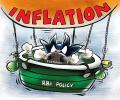
The Reserve Bank of India has increased its retail inflation projection for 2026-27 to 5.1 per cent, up from an earlier estimate of 4.6 per cent. This revision is primarily attributed to mounting input costs, driven by the pass-through of higher global energy prices to domestic petrol and diesel rates, which have seen significant increases since May.

The Indian banking system's net liquidity surplus has reached a four-year high of Rs 4.57 trillion, driven by maturing government securities, with further maturities expected to push the surplus to around 5 trillion.

Reserve Bank of India (RBI) Governor Sanjay Malhotra stated that preventing second-round effects of supply shocks, where inflation expectations rise due to prolonged disruptions, is the primary role of monetary policy. He also defended the RBI's foreign exchange market interventions, asserting it did not commit to an 'indefensible peg'.

The primary objective of introduction of polymer notes was to increase its life and not to combat counterfeiting.
The Reserve Bank of India (RBI) has introduced stricter timelines for banks to process inward cross-border remittances, aiming to reduce delays in crediting funds to beneficiaries by mandating immediate customer intimation and more frequent nostro account reconciliation.

Indian stock market indices closed on a mixed note, with the Sensex gaining 374 points driven by buying in Reliance Industries and ICICI Bank, while the Nifty remained flat. This divergence is attributed to a new Closing Auction Session (CAS) mechanism introduced by stock exchanges, impacting market liquidity and price discovery.

'You have to get private investment to somewhere between 35% to 36% of GDP. It is hovering about 30%-31%.'
Indian stock market benchmarks, Sensex and Nifty, saw gains in early trading, driven by anticipation surrounding the Reserve Bank of India's monetary policy decision, despite mixed global cues and significant FII outflows.
"It is quite possible that the rates will remain low in the near to medium term, but that will depend on how conditions evolve," said RBI Governor Sanjay Malhotra.
Most members of the Reserve Bank of India's Monetary Policy Committee (MPC) expressed concerns about inflation becoming generalised and highlighted uncertainties surrounding both inflation and growth prospects due to the West Asia conflict, according to the recently released minutes.

'A balance had to be struck between the economic cost of taking action at this point against the need not to fall behind the curve in controlling inflation and anchoring inflation expectations.'

Sanjay Malhotra has made structural changes to banking regulation to bring down costs and increase efficiency. Plus, he kicked off a benign interest regime. But there are challenges ahead.
The central bank is yet to consider actions such as a rate hike or mobilising dollar inflows from non-resident Indians to boost forex reserves as it cannot afford to continue with them for long when the rupee's internationalisation tops its agenda, explains Tamal Bandyopadhyay.

Lack of women in Karnataka's new council of ministers has put the spotlight once again on women's under-representation in politics and policy.

The RBI once again said the Tata group holding company's application for deregistration as an NBFC remains under examination.

Gopalakrishna's name was in the reckoning for Deputy Governor in place of Anand Sinha who retired in January.
The Reserve Bank of India (RBI) has kept its key lending rate, the repo rate, unchanged at 5.25 per cent for the second consecutive time, citing concerns over rising energy prices, supply disruptions from the West Asia crisis, and potential inflationary pressures.

The central bank cut SLR to 23 per cent from 24 per cent.

Reserve Bank of India (RBI) Governor Sanjay Malhotra stated that recent regulatory measures to address foreign exchange market volatility, such as capping banks' net open positions, are temporary and aligned with current market conditions, not signalling any structural shift in policy.

Stock markets closed higher on Friday after the Reserve Bank of India kept its benchmark interest rate unchanged as expected and proposed allowing banks to lend to Real Estate Investment Trusts (REITs) with certain prudential safeguards to deepen the financing pool for the real estate sector.
The RBI on March 12 approached the Election Commission seeking its approval for granting bank lincences as the model code of conduct had come in place after the general elections announcement on March 5.
